Inside Cardano’s Snap Election: Restoring the Constitutional Committee
Over the last few weeks, the community has focused on an important task: restoring Cardano’s Constitutional Committee (CC) to its minimum operational size.
Following recent changes in membership, the CC temporarily dropped to six members. Under CIP-1694, this places limits on its ability to ratify governance actions. To address this, Intersect facilitated a snap election to fill one vacant seat and bring the CC back to a minimum of seven members.
That election has now concluded. In this blog, we want to do two things:
- Share what happens next, including the Update Committee governance action we have submitted, and
- Explain how the Civics Committee thought about the result, particularly given how close the race was between first and second place.
Our goal is to be as transparent as possible about the trade-offs, so members and the community can see not only the outcome but also the reasoning behind it.
The snap election: one seat, a very close result
The snap election ran from 17 November to 5 December, with DReps voting to identify a candidate to be proposed formally on-chain and fill a single vacant CC seat.
- The election was publicly announced as a contest for one seat.
- The rules, expectations, and communications all described a single winner who would restore the CC from six to seven members.
- Some DReps participated, representing a broad range of delegated ada.
The audited results recorded a total of 3,160,499,917 ada participating stake represented by 88 DReps on the Ekklesia platform. Cardano Curia received support from 33 DReps, representing 1,679,248,296 in ada stake while Christina received support from 44 DReps, representing 1,402,136,349 in ada stake.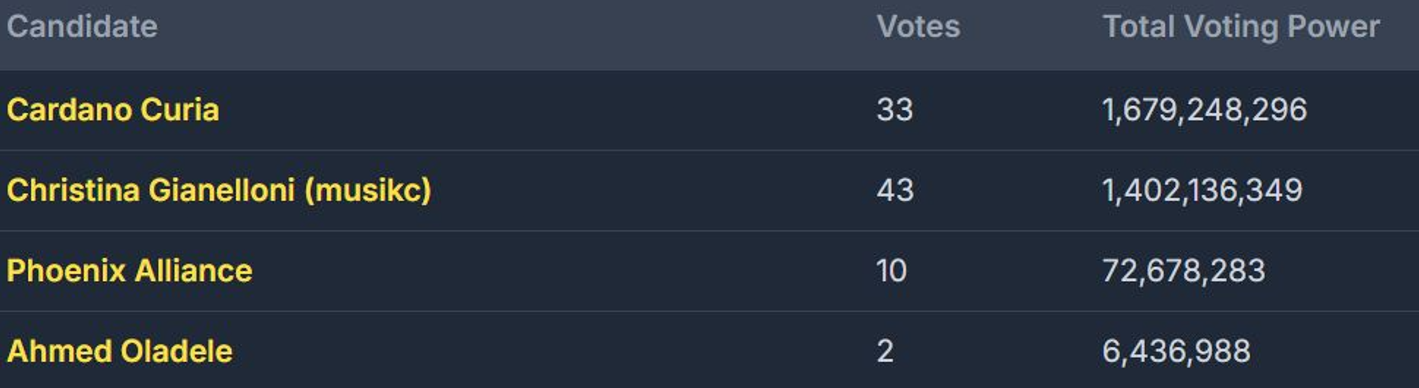
In ada voting power, Cardano Curia finished narrowly ahead, while Christina Gianelloni received more individual votes. Together, these numbers underline just how closely matched the two frontrunners were and why the result deserved careful consideration.
This created a natural question. Given the tight result and the current pressure on governance, should we:
- Add one member, as communicated initially, or
- Add two members, bringing the CC from six to eight, to increase resilience and capacity?
Whilst options on the surface appear straightforward, there are considerations to be made when choosing. So the Civics Committee took some time to map out the options, seek input, and consider the consequences.
The options members considered
The Civics Committee evaluated three main paths.
Option 1: Add one member now (restore to seven)
This option does exactly what was communicated at the outset. Cardano Curia, as the first-place candidate in ada voting power, joins the CC, restoring it to seven members and returning it to an active state.
Benefits:
- Respects the integrity of the snap election as it was announced and understood by voters.
- Restores the CC’s ability to ratify governance actions as quickly and cleanly as possible.
- Avoids any perception that the rules were changed after the vote to produce a different outcome.
Risks:
- Misses the opportunity to add more resilience immediately with an eighth member.
- Leaves the CC vulnerable. Another resignation could bring it back down to the minimum again.
Option 2: Add two members now (expand to eight)
Under this option, both Cardano Curia and Christina would join the CC, increasing membership from six to eight.
Benefits:
- Increases resilience. The CC could lose one member and remain above the minimum size.
- Signals that we are listening to those who called for two seats, especially given such a close result.
- Aligns with a potential long-term direction of expanding the CC.
Risks:
- Voters took part in an election that was clearly communicated as having one seat. Changing to two winners after the fact raises legitimacy concerns.
- It could be perceived as seat inflation or political manoeuvring, even if the intent is positive.
- Requires revisiting and rewriting the governance action and justification under time pressure, which can create confusion and fatigue for all involved.
Option 3: Add one now, consult later on expansion
A third path would be to restore the CC to seven members as planned, then launch a separate consultation and governance process on whether to expand the CC to eight.
Benefits:
- Maintains the integrity of the snap election by filling exactly one seat, as communicated.
- Acknowledges the strong performance of the second-place candidate and opens a path to explore expansion with proper consultation.
- Gives the wider community a chance to participate in a structural decision, rather than making that decision in the middle of an emergency election.
Risks:
- Slower to achieve any extra resilience that might come from expansion.
- Adds work for the CC, DReps and Intersect at a time when many are already stretched.
Why the Civics Committee chose Option 1 (with an alternate)
After weighing these trade-offs, members of the Civics Committee agreed to proceed with Option 1, with an additional refinement.
- Restore the CC from six to seven members as communicated initially.
We will submit an Update Committee governance action that adds Cardano Curia as a member. Once SPOs and DReps ratify this action on-chain, the CC will return to its minimum operational size of seven and be fully able to vote on governance actions again. - Invite the second-place candidate to serve as an alternate.
The Civics Committee will invite Christina Gianelloni to serve in an alternate capacity. This means that, if the CC were to fall below the minimum size again in the near future, there is already a clear, community-endorsed candidate ready to step in through a follow-up Update Committee governance action, without needing to run another emergency election.
This approach tries to balance three important principles and next steps:
- Legitimacy and clarity. We do what we told the community we would do: elect one seat. The winner, in ada voting power, takes the seat. The election result stands exactly as communicated.
- Speed and governance continuity. We restore the CC’s functionality as quickly as possible so it can focus on its core job of reviewing and ratifying governance actions.
- Resilience and respect for the close result. By recognising Christina as an alternate, we acknowledge the strength of support she received, both in ada and in the number of votes, and we reduce the time and friction needed to respond if another vacancy arises.
- Recognizing the recommendation from the Parameter Committee to reduce the minimum Constitutional Committee size from seven to five members, to be deliberated on by the community and raised as a Parameter change in early 2026.
This is not a perfect solution, but it is a pragmatic one that respects both the letter and the spirit of the process.
What alternate means in practice?
It is important to be clear about what an alternative is and is not.
- An alternate is not a sitting member of the Constitutional Committee and is not represented on-chain. They do not participate in decisions or votes.
- An alternate, defined here, is a candidate who has already demonstrated significant community support and is ready to step forward if the CC falls below the minimum size again.
- If that happens, a separate Update Committee governance action would still be required, and SPOs and DReps would retain the final say on-chain.
This keeps the core governance rules intact. It also gives us a clear, fair, and transparent path to respond more quickly if the CC loses another member.
What happens next
On 9 December 2025, Intersect will submit an Update Committee governance action that:
- Adds Cardano Curia to the Constitutional Committee,
- Restores the CC from six to seven members in line with the original snap election communication, and
- Returns the CC to an active state, fully able to consider and vote on governance actions.
This action is now live. We will:
- Encourage SPOs and DReps to cast their votes so the CC can be restored without unnecessary delay.
- Have informed Christina of the approach voted on by the Civics Committee, and she is considering her options.
View and vote on the Update Committee governance action here
In parallel, the Civics Committee plans to review the long-term size and structure of the CC as part of the broader 2026 governance roadmap, including proposing to reduce the minimum committee size. Questions like whether the CC should eventually expand to eight or more members are important, but they are best handled through considered consultation, not improvised during an emergency.
Thank you to candidates and the community
Finally, we want to recognise the effort and commitment shown throughout this process.
To Cardano Curia, Christina Gianelloni, and all candidates who stood in the snap election, thank you for your willingness to serve and for engaging in a compressed, high-pressure process.
To the DReps who took the time to understand the context, participate in discussions, and cast votes, thank you for helping Cardano’s new governance processes come to life.
To members of the Civics Committee and the broader Intersect membership who helped analyse options and think through the trade-offs, thank you for leaning into the complexity rather than looking for an easy headline.
Intersect’s role is to support a governance system that is transparent, predictable, and resilient. Sometimes that means making difficult choices in less-than-ideal circumstances. By choosing Option 1 with an alternate, we aim to respect the process, restore the CC quickly, and keep the door open to thoughtful, community-driven improvements in the future.
We look forward to working with the restored Constitutional Committee, our members, and the wider Cardano community as we move into the next phase of on-chain governance.