Building a 2026 Ecosystem Budget for Cardano
A proposed framework for community approval
Through the Budget Committee, an Info Action has been submitted proposing a framework for how the Cardano ecosystem could coordinate a budgeting cycle in 2026.
This action asks DReps a simple question.
Should the ecosystem use this structured process to organize the 2026 budget cycle?
The vote does not approve a budget and it does not select proposals for funding. Instead, it signals whether the community supports using this framework to run the 2026 budgeting process. If the framework receives majority support from active voting stake (over 51%), the process can begin and proposals for ecosystem initiatives can start being collected.
Intersect would facilitate coordination of the process, helping collect proposals, support community review, and consolidate approved initiatives into Treasury Withdrawal governance actions.
Final funding decisions remain entirely with ada holders through Cardano’s on-chain governance system.
Why a defined budget process matters
The Cardano treasury represents one of the most significant decentralized funding pools in the industry. It provides the ecosystem with a powerful opportunity to invest in infrastructure, innovation, and long-term network growth.
At the same time, many community discussions over the past year have focused on sustainability, measurable impact, and responsible treasury management. Contributors across the ecosystem have emphasized the importance of ensuring that treasury resources are deployed thoughtfully and in ways that strengthen Cardano’s long-term economic health.
A clear and predictable budgeting process helps address these concerns. It provides structure for evaluating proposals, enables meaningful comparison between initiatives, and supports transparency in how treasury resources are allocated.
The experience of the 2025 cycle demonstrated that decentralized budgeting can work, while also revealing areas where additional clarity and structure would help the ecosystem operate and navigate funding decisions more effectively.
Common challenges from 2025 included:
- Lack of a clearly defined and approved process at the outset
- Proposals submitted in inconsistent formats, with multiple tools.
- Difficulty comparing initiatives objectively
- Heavy review workload for DReps
- Limited linkage between funding requests and ecosystem strategy
- Misalignment between off-chain review and on-chain governance thresholds
The proposed framework for 2026 builds on those lessons and aims to provide greater clarity, comparability, and transparency across the entire budgeting cycle.
Community consultation and lessons from 2025
The proposed framework has been developed by the Budget Committee through several rounds of consultation with DReps, ecosystem contributors, and prospective & current vendors. These discussions took place across community calls, working sessions, and direct feedback from participants involved in the 2025 budgeting cycle.
The goal of this consultation process was to identify where the previous cycle worked well and where improvements could help the ecosystem operate more effectively. Feedback from DReps highlighted the need for clearer proposal structure, better comparability between initiatives, and stronger connections between funding requests and ecosystem strategy. Vendors and builders emphasized the importance of predictable timelines, clearer submission guidance, and a transparent review process.
The resulting framework reflects those discussions. It aims to preserve the strengths of the 2025 process while incorporating practical improvements that make the budgeting cycle more structured, transparent, and easier for the community to navigate.
As with all governance processes on Cardano, the framework is expected to continue evolving over time as the ecosystem gains further experience and feedback from future cycles.
Preconditions for the annual budget cycle
Before the ecosystem budget process begins each year, three items must be approved on-chain:
- A strategic vision and priorities for the ecosystem
- A defined Net Change Limit (NCL)
- A Budget Process framework
With both the strategic vision and NCL already in place, the next step is to establish a clear budgeting framework ahead of the 2026 cycle.
This sequencing ensures that treasury spending is guided by shared strategy, clear guardrails, and predictable governance mechanics.
The process also operates within Cardano’s constitutional safeguards, including the Net Change Limit. This limit helps ensure treasury withdrawals remain within sustainable parameters while still allowing the ecosystem to invest in meaningful growth.
From grants to strategic delivery
The 2025 budgeting cycle already introduced milestone-based delivery, smart contract disbursements, and early strategic alignment through the ecosystem’s first product strategy.
The 2026 framework builds significantly on that foundation. With the recent approval of the Cardano Vision 2030 and its associated ecosystem KPIs, the budgeting process can now operate within a clearer long-term strategic framework. This makes it easier to evaluate proposals based on how they contribute to measurable ecosystem outcomes.
This shift aims to ensure that treasury spending supports real ecosystem outcomes while giving DReps the information needed to make more informed funding decisions.
Key improvements include the following.
Strategic alignment
Proposals are strongly encouraged to align with the Cardano Vision 2030 strategic framework and identify measurable ecosystem outcomes through relevant KPIs.
This allows DReps to compare initiatives not only by narrative but by expected contribution to the ecosystem.
Standardized proposal structure
All proposals follow the same template, enabling clearer comparison between initiatives and helping reviewers evaluate expected value more effectively.
Clearer participation thresholds
To focus the process on meaningful initiatives:
- Minimum proposal size: 100,000 ada
- Submission contribution: 1,000 ada donation to the treasury
These measures help ensure that proposals entering the process represent serious initiatives and reduce the likelihood of spam or low-effort submissions.
Simplified treasury approvals
The framework also simplifies the transition from community review to on-chain governance.
Proposals that achieve at least 67% support from participating DRep stake during the off-chain voting stage (using Hydra) move forward to Treasury Withdrawal governance actions.
This approach aligns the process with the current constitutional structure while reducing unnecessary voting fatigue.
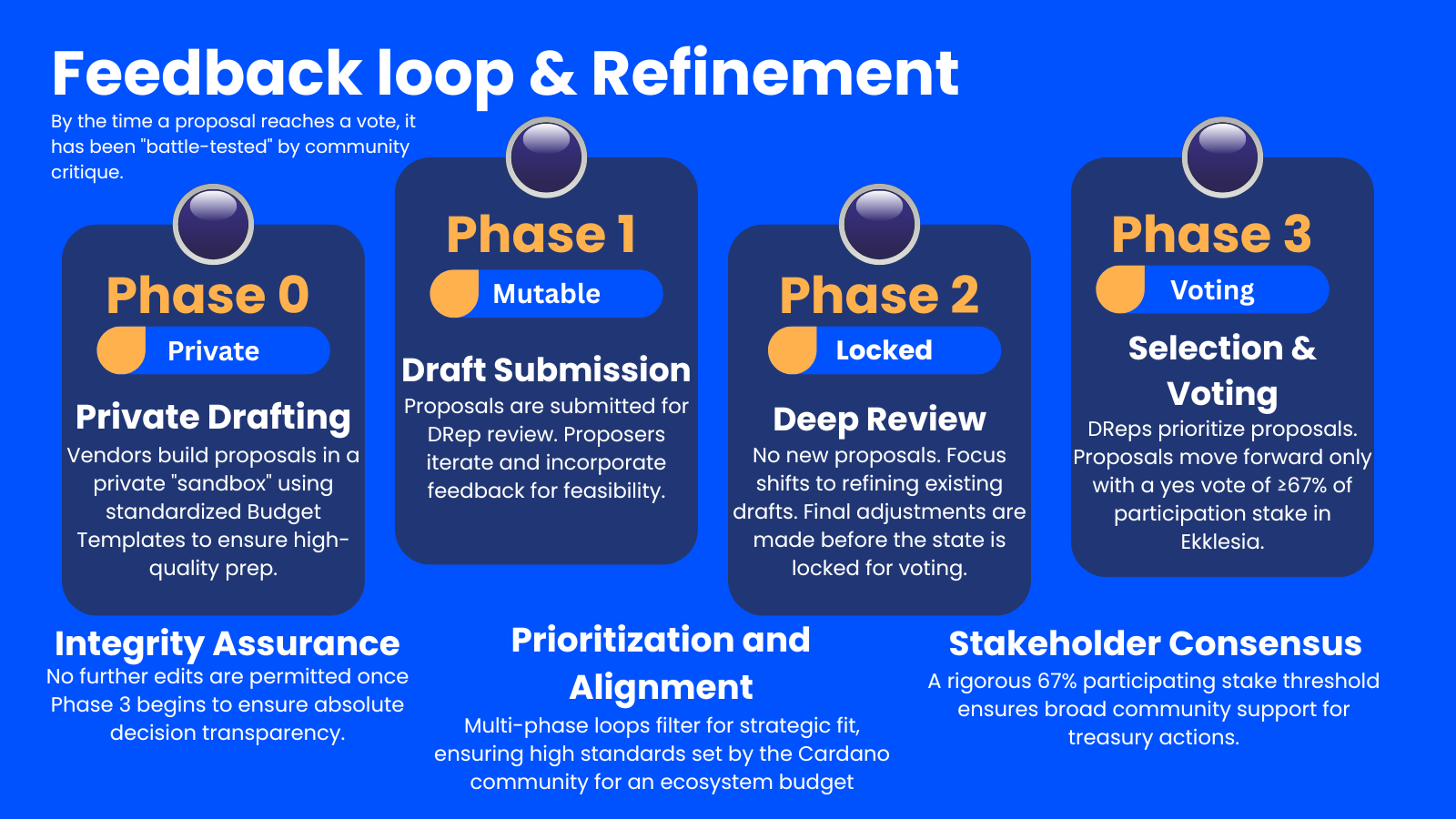
The proposal refinement loop
One of the most significant improvements for 2026 is the introduction of a structured feedback and refinement cycle before proposals reach the voting stage.
This approach encourages collaboration and helps ensure proposals are well developed before final decisions are made.
The phases include:
Private drafting and preparation
Proposers develop their submissions using the standardized template in a private environment before public review begins.
Community review and iteration
Draft proposals become visible to the community. Proposers can incorporate feedback and improve their submissions during this phase.
Deep review and finalization
Once the submission window closes, proposals undergo deeper review by DReps. Final adjustments are made before proposals are locked for voting.
Once voting begins, proposals cannot be edited. This protects fairness and transparency.
Consolidation and treasury submission
Proposals that meet the approval threshold move into the consolidation stage.
During this phase:
- Proposals are ranked by level of DRep support
- Initiatives are evaluated against the available Net Change Limit
- Approved items are consolidated into Treasury Withdrawal governance actions
This step ensures treasury spending remains within constitutional limits while reflecting ecosystem priorities identified through the review process.
Importantly, participation in this process is optional. Proposers may still submit Treasury Withdrawal governance actions independently through Cardano’s standard governance mechanisms, and DReps remain in control of approving proposals at the treasury withdrawal stage.
Execution and monitoring
Once (and if) treasury withdrawals are approved on-chain, projects move into the execution stage.
Where Intersect is selected as Administrator and agrees to perform the role, it supports operational delivery by helping coordinate:
- Vendor onboarding and compliance checks
- Contract preparation
- Smart contract based milestone payments
- Transparent reporting and oversight
Treasury funds are typically held in smart contracts that enable milestone-based payments. This approach improves transparency and helps ensure funds are released in alignment with delivered work.
An independent Oversight Committee participates in the smart contract control framework to provide additional checks and balances on administrative actions.
This role supports the execution of governance decisions but does not influence which proposals receive funding.
Planned timeline for the 2026 cycle
While dates may adjust slightly, the intended timeline is as follows.
Early March 2026
Budget Process Info Action submitted for DRep vote.
Mid March
Budget tooling and submission platform available.
Early April
Proposal submission window opens.
April to May
Community feedback and proposal refinement through the review loop.
Mid to late May
Off-chain DRep advisory voting through Ekklesia.
June
Proposal consolidation into Treasury Withdrawal governance actions.
Mid to late June
Treasury Withdrawal governance actions submitted on-chain.
Late August or early September
Expected first milestone payments for approved initiatives.
This timeline is designed to give proposers, reviewers, and governance participants clear participation windows throughout the process.
What DReps are being asked to approve
This Info Action records the framework used to run an ecosystem budget process, facilitated by Intersect. It does not approve spending and it does not select proposals.
Instead, it asks whether the ecosystem should adopt this structured process for coordinating a 2026 budget cycle.
If the framework receives majority support from active voting stake, the process can begin and proposals for ecosystem initiatives can be submitted.
Building Cardano governance
Cardano’s treasury is one of the ecosystem’s most important strategic resources.
A clear and transparent budgeting process can help ensure those funds are deployed responsibly, aligned with community priorities, and focused on creating long-term value for the network.
The proposed framework reflects lessons learned from earlier funding models and aims to provide a more disciplined and accountable approach for future treasury allocation.
As always in Cardano governance, the outcome depends on community participation and consent.
DReps are encouraged to review the Info Action and signal their support if they believe the proposed framework provides a clear and effective path for coordinating the 2026 budget cycle.