Intersect weekly update #137 Nov 15, 2026
Welcome to Intersect’s update #137
Node Diversity Workshop: what builders, SPOs and DReps took away from two days in London. 23 million ada back where it belongs: unused Catalyst funds returned to the treasury, on the record. Node 11.2.1: memory fixes, and LSM approved for block producers, CAP-12: the discussion turns to the numbers behind the guardrails.
This week’s action: have your say on CAP-12 while it’s still open at cap.intersectmbo.org.

Latest on Cardano upgrades
Cardano node version 11.2.1 was given Pre-Release status on Monday (November 9). This is the recommended node for operators on DijkstraNet. Mainnet approval is expected shortly and provides a number of performance improvements, including fixes for memory usage issues found in 11.1.x releases and faster snapshots while syncing. The headline announcement for this release is that LSM has finally been approved for use on block producer nodes on all networks, offering an option for reduced memory usage for operators running nodes with limited resources. See release benchmarking and system tests for more details. Block headers have also been updated to 11.3 for those who like to track node adoption statistics on various explorers.
You can stay up to date by reading Intersect’s weekly Upgrade Bulletin.
With the Dijkstra hard fork in preparation, things move quickly. Every week, Intersect publishes an Upgrade Bulletin as an article on X which sets out what’s changed and what you can do now, by role, whether you run a stake pool, build tools or dApps, or vote as a DRep. It also regularly has a table showing which node, CLI and db-sync versions to run on each network. Start with this week’s edition: Upgrade Bulletin 42, and subscribe to notifications on Intersect's main X account to keep tabs on when its time for you to act.
Constitutional Amendment Portal (CAP) updates
CAP-12 - Have your say while it's still open.
CAP-12 sets out the constitutional changes needed for the Dijkstra era. It covers the guardrails for new parameters, including those for Linear Leios. Each version brings the text closer to final iteration, and once it’s final, it goes on-chain as a governance action to update the Constitution, and the time for changes has passed. If you want to shape it, now’s the time.
This week, the discussion moved focus from the wording of the guardrails to the numbers behind them:
Reference script fees. A public review found these fee settings need to be limited together, not one at a time, or fees could rise sharply. It proposes firmer limits, and a published security assessment for any change that weakens protection against denial-of-service attacks.
The Leios off switch. The version 5 text had removed it. A proposed position for the Technical Steering Committee would bring it back, with a clear way to switch Leios off once it’s been tested. The committee is due to review this on November 18.
Raising Leios capacity. New guardrails are proposed for how throughput is increased over time, including limits on each step and checks that stake pools are ready. A provisional cost analysis comes with them. If you run a stake pool, this is worth reading.
Version 6, with the proposed parameter values, is expected next.
How to take part: read the latest version and comment in the CAP-12 thread. DReps, SPOs and the Constitutional Committee all have a stake, and early input helps avoid friction when the governance action arrives.
Other CAPs: CAP-2, CAP-9 and CAP-10 each received new endorsements this week. CAP-3 stays on version 4 and will follow the 2027 Cardano budget process.
Get started: head to cap.intersectmbo.org
Recently closed governance actions
There were no recently closed governance actions to report this week. Read on for all currently open actions, with one closing this weekend on November 15, 2026.
Live governance actions1
| Proposal | Expires | Votes | CC (🟢-🔴-⚪️-⏳) |
|---|---|---|---|
| Cardano Strategic Copper Reserve | ₳22M RWA Tokenization (Treasury Withdrawal) |
Nov 15, 2026 (Epoch 668) |
DRep 0.48% / 67% |
0-3-0-4 |
| AURORA: Open infrastructure for bringing real credit markets to Cardano. (Treasury Withdrawal) |
Nov 20, 2026 (Epoch 669) |
DRep 4% / 67% |
0-3-0-4 |
| PFMS: Bringing Government Scale Adoption to Cardano by Trivolve Tech (Treasury Withdrawal) |
Nov 20, 2026 (Epoch 669) |
DRep 29.65% / 67% |
3-0-0-4 |
| State of the Cardano Developer Ecosystem - 2026 Survey (Info Action)2 |
Nov 30, 2026 (Epoch 671) |
DRep 10.38% SPO3 0% |
2-0-0-5 |
1data from 2026-11-13 at 11:15 UTC
2 An Info Action used as a survey call-to-action, explicitly states that any on-chain response could be recorded using an Abstain vote
3 SPO votes on Info Actions are not mandatory, however the ledger allows a response to be recorded
Follow vote progress with your favorite Cardano explorers:
GovTool | Tempo | Cexplorer | AdaStat | CardanoScan | CGov | Civitas | DRepTalk
Administration services updates - 23 million ada back where it belongs
When treasury funds aren't needed, they go back. In the last week, Intersect facilitated a combined return of 23,063,600 ada to the Cardano treasury in two transactions on November 6 and November 10.
The funds were set aside in last year’s budget for Project Catalyst: 21 million ada for Fund 15, and 2,063,600 ada for the remaining milestones of IO’s Catalyst operations contract. With Catalyst administration moving from Input Output to the Cardano Foundation, neither amount was needed. So it went home, to the treasury, where the community decides what happens to it next.
You don’t have to take our word for it - Intersect administers treasury funds on the community’s behalf, but administering them doesn’t make them ours. Every ada sits in treasury smart contracts, every movement is on-chain, and every return carries its reason in the transaction metadata. Anyone can check:
The running total
Including earlier returns from the Product budget, Intersect has now returned 23,178,772 ada to the treasury, that’s 95.88% of all ada sent back to the treasury, as of November 13, 2026.
This is exactly how a community treasury should work: funds used for what was agreed, and anything left over returned, visibly and on the record.
Delivery Assurance Vendor Milestone updates - Lowering the barriers to using Cardano
IO delivered two milestones last week that aim to make Cardano easier and cheaper to use.
Babel fees: a first working version lets you pay transaction fees in tokens you already hold, such as stablecoins, instead of ada.
CIP-159, phase 1: adds direct deposits and partial withdrawals to Cardano accounts, the groundwork for small payments. It’s running on testnets ahead of the Dijkstra hard fork.
Both are funded through the treasury and administered by Intersect. As always, all Intersect-administered project milestones can be monitored on the treasury dashboard.
Connecting with the community
Cardano community members came together November 12 and 13 for the Node Diversity Workshop in London, hosted by the Amaru team. Node builders, SPOs, DReps and core developers spent time debating what it means to do things “The Cardano Way”.
A node is the software that runs the network: it validates transactions, produces blocks and keeps the ledger in sync. For most of Cardano’s history, there has been one main implementation, the Haskell node. Today, independent teams are building others in languages such as Rust, Go and TypeScript. More implementations mean no single codebase, or single bug, can take the network down, and more teams able to contribute to Cardano’s future. It also means more coordination, so upgrades and standards work for everyone.
Day two was described as an “unconference” which meant participants decided what was being discussed. The focus of discussions turned to how several nodes work together in practice with:
- Testing: an Antithesis demo, and a session on conformance testing for alternative nodes.
- Upgrades and process: the Dijkstra CIPs, KtorZ, the CIP process (Nick Clarke, Intersect), hard forks in a multi-node era (Bosko Majdanac, Intersect’s Hard Fork Working Group), and the Leios rollout plan (Leonard Hegarty, BlockPQR).
- Security and performance: a security session (Kevin Hammond, Intersect TSC and Ensurable Systems) and OpenBlockPerf (Markus Gufler, Cardano Foundation).
- Amaru in action: running Amaru as an SPO (Chris, STR8 Pool) and a live node demo from the Amaru team.
Attendees shared their takeaways which highlighted much common ground. One attendee said: “Reaching consensus on consensus is hard, but the problem space is smaller than I expected, because we agree on most things.” Other themes:
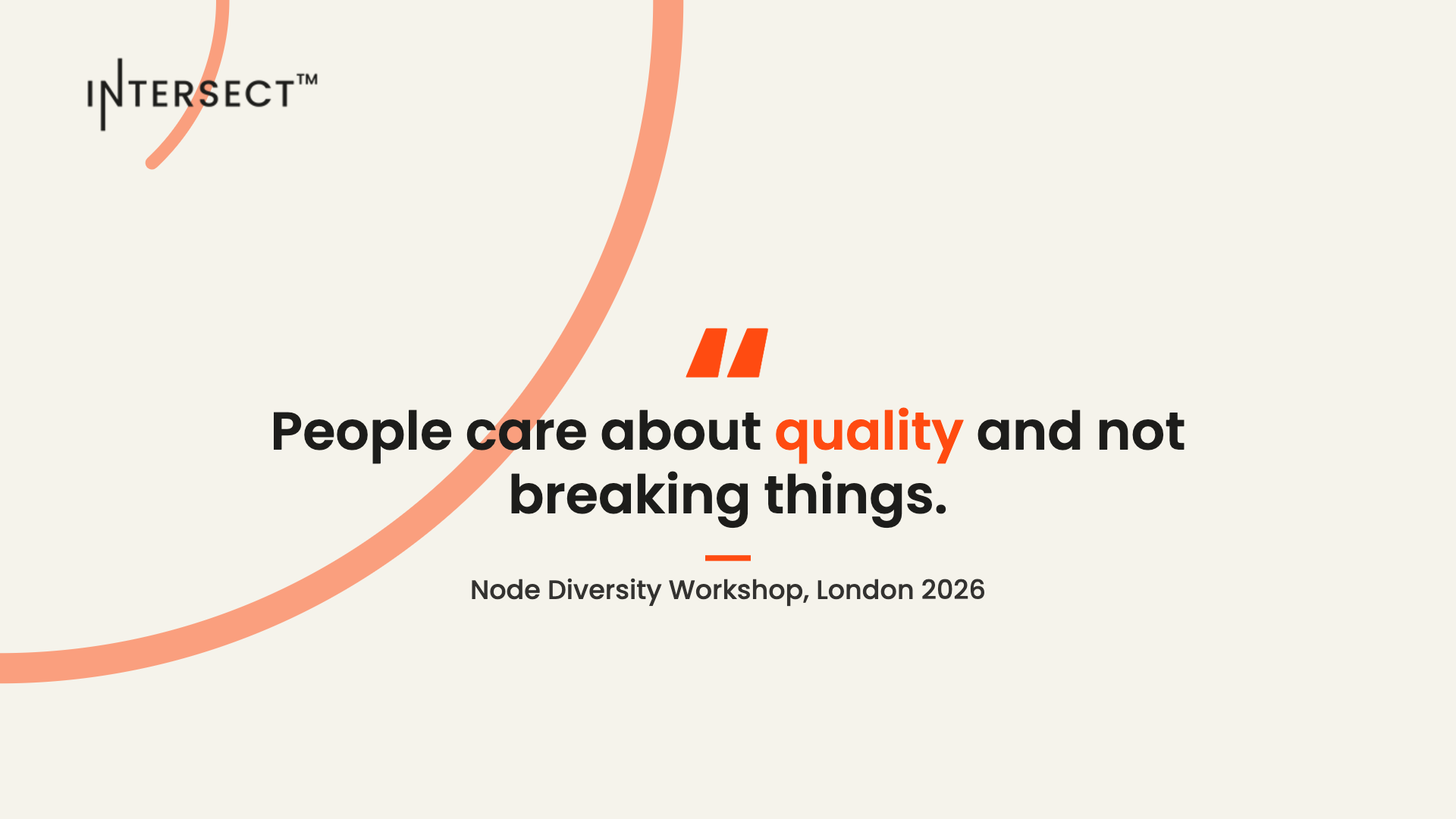
- Quality first. “The community wants a conformance testing standard. More nodes are ready to go to mainnet. People care about quality and not breaking things.”
- Bring everyone in early. “What we have today with CPS and CIP flow is already a good start. Important to involve SPOs, DReps, and different node implementers early.”
- Keep the user in view. Several notes asked who Cardano is building for, and called for real, customer-driven use cases.
- Being in the room matters. “30-60 minute Google Meets cannot compete with events like this.”
Thank you, Amaru!
Thank you to the Amaru team for making this happen, and to everyone who took part. Events like this depend on people stepping forward to organize them, and the ecosystem is richer for it.
What’s next?
We’ve seen the value of bringing the technical community together in person. Intersect is working on plans to host future Node Diversity Workshops, with the Technical Steering Committee, and will share details soon.
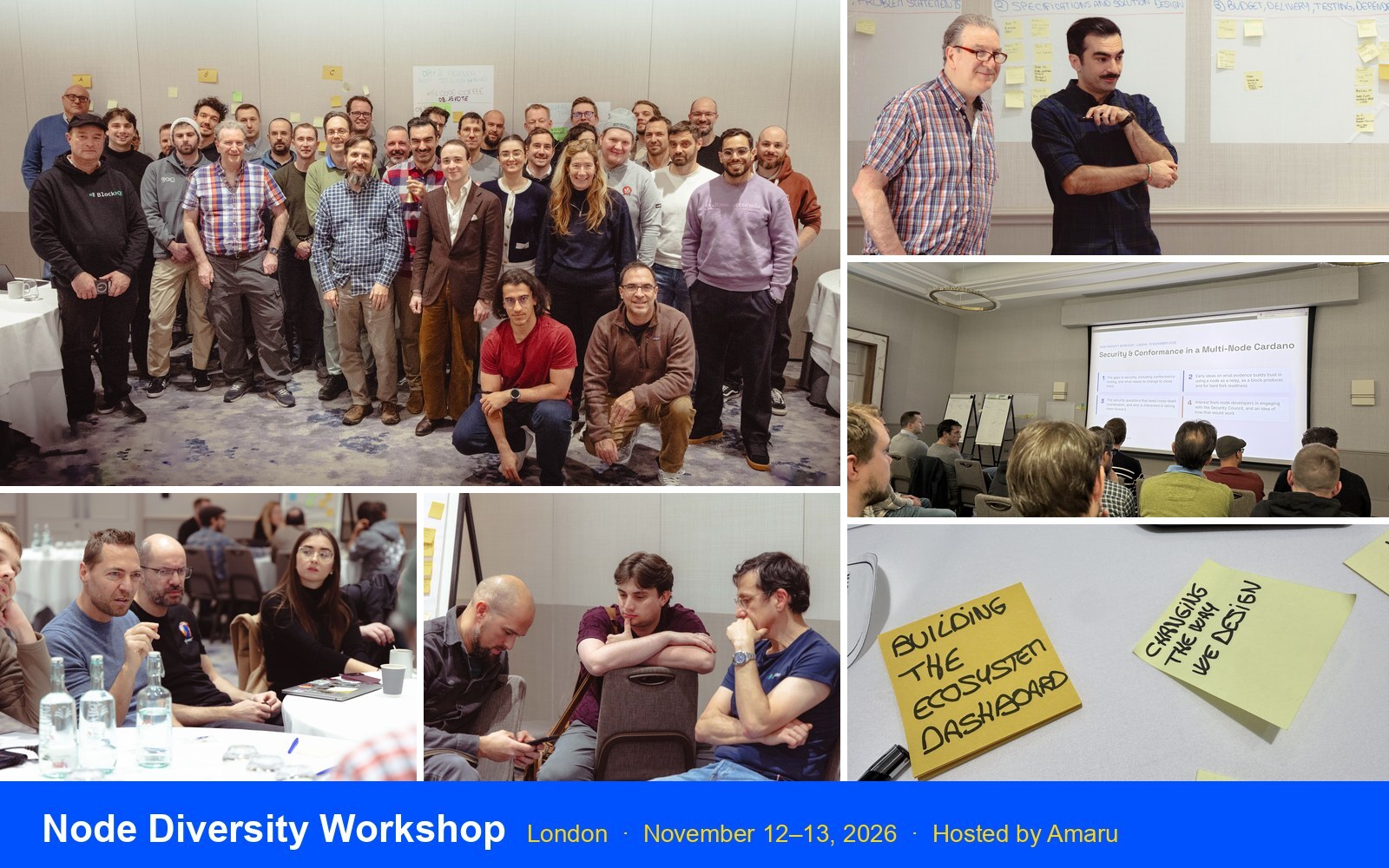
Images above credit and thank you to Cardano Foundation's Sebastian - the unsung hero of so many events - for the capturing, recording and documenting of this workshop.
Enterprise Member Spotlight: Shielded Technologies
This week, the Membership and Community Committee (MCC) are spotlighting Intersect Enterprise Member Shielded Technologies.
Shielded Technologies describes itself as a blockchain engineering company focused on developing privacy-enhancing technologies, zero-knowledge (ZK) cryptography, and decentralized infrastructure to support real-world applications.
Shielded explained the company emerged as a spinout of Input Output, the engineering organization behind Cardano, and serve as a core technology partner and developer of the Midnight Network.
Shielded highlights its work on Midnight, a blockchain network designed to support privacy-preserving applications through zero-knowledge proofs, a dual-state ledger architecture, and selective disclosure capabilities. According to the company, these technologies are intended to enable individuals and organizations to protect sensitive information while supporting verification and regulatory requirements.
The company also describes its activities across blockchain protocol development, network infrastructure, cryptographic research, ecosystem tooling, and open-source development. Its work includes developing components of the Midnight protocol, supporting network operations, and building tools for privacy-focused applications.
Shielded further highlights its involvement with the Linux Foundation Decentralized Trust, where it participates in initiatives focused on open-source development and privacy-enhancing blockchain technologies.
As part of our Enterprise Member Spotlight series, we're pleased to introduce Shielded Technologies to the wider Intersect community and provide an opportunity for members to learn more about its work across blockchain infrastructure, privacy-enhancing technologies, and the Midnight ecosystem.
🔗 Learn more about Shielded Technologies:
https://www.shielded.io/
Enterprise Member Spotlights are intended to showcase the work and activities of Intersect members. Information about products, services, capabilities, and activities is provided by, or based on information published by, the featured member and does not constitute an endorsement by Intersect.
What’s on next week
Would you like your Cardano event to be included in our "What's on section?" let us know - open a support ticket in our Discord, or drop us an email at members@intersectmbo.org
| Date and time UTC | Event | What’s happening / who it’s for | Link |
|---|---|---|---|
| Sat, Nov 14 · 06:30 | Cardano First Steps in North-Kivu - French language | Beginner-friendly community led session covering Cardano, governance, wallets, DeFi and ways to contribute. Hosted by Baudouin Muvunga on Google Meet. | Details and registration |
| Sat, Nov 14 · 12:00–14:00 | Cardano Indonesian Town Hall #10 | Indonesian Community Technical and ecosystem updates, including governance, adoption, funding, scaling, security and community Q&A. Online via Zoom; registration requires approval. | Register |
| Mon, Nov 16 · 13:00 | Cardano Research Exchange: SPO and Delegator Incentives - Part 2/2 | Manvir Schneider and Juan Ignacio Beccuti Vázquez explore the reward pot, reserve depletion and long-term sustainability, including monetary expansion, treasury share, fees and block capacity. SPOs and delegators are encouraged to challenge the findings. | Details and joining link |
| Mon, Nov 16 · 14:30 | Privacy panel featuring Midnight | Sébastien Guillemot joins representatives from NEAR Intents, Castle Labs and Humanity Protocol to discuss applications that disclose only necessary information. Part of House of Chimera’s “The Privacy Stack” X Space, which runs 13:00–16:40. | Join the X Space |
| Tue, Nov 17 · 16:00 | Intersect Hard Fork Working group call | Hard fork working session. Anyone can observe, with interaction invited. Google Meet every Tuesday. | Register & Join |
| Tue, Nov 17–Thu 19 | Bengaluru Tech Summit - Discover Cardano | In-person conference in Bengaluru, India, listed on Cardano’s official events calendar as a Discover Cardano event. | Conference website |
| Wed, Nov 18 · 16:00–17:00 | SPO Table Talk: Understanding minMargin and Its Impact on Stake Pool Economics | Discussion of minimum percentage margins, pool sustainability, competition, delegator rewards and stake distribution. Participants listed include Markus Gufler, Kevin Hammond and SPO representatives. | Watch on YouTube · Event details |
| Thu, Nov 19 · 14:30 | DB-Sync Technical Working Group — Open Session | Intersect’s open technical working group session, relevant to developers and teams using Cardano chain data. Google Meet; no detailed agenda published on the listing. | Register |
| Fri, Nov 20 · 09:00–10:00 | Cardano Foundation Developer Office Hours #88 | Scheduled developer session: “Blockchain QA: From Testing to Security” with Luis Zarate, QA engineer at the Cardano Foundation | Event listing |
That’s it for this week’s update. Thank you for reading. To learn more about Intersect’s work, explore the Knowledge Base, which provides detailed information on governance structures, committees, and funding.
Join the conversation by becoming an associate or a member via the Intersect Member Area, and follow us on Twitter (X) and LinkedIn to engage with fellow members, working groups, and the broader community. Subscribe to the public Google and Luma calendars.
Your voice helps shape the future of Cardano governance.