The 2026 Constitutional Committee Elections
The Cardano ecosystem is approaching what is becoming a yearly tradition in governance. As the terms for four of the seven Constitutional Committee (CC) members draw to a close this September, it is time to look toward the next chapter of on-chain checks and balances.
The CC election is a vital piece of Cardano’s governance structure. Whether you are a veteran of the ecosystem or a newcomer looking to make an impact, here is everything you need to know about the upcoming cycle.
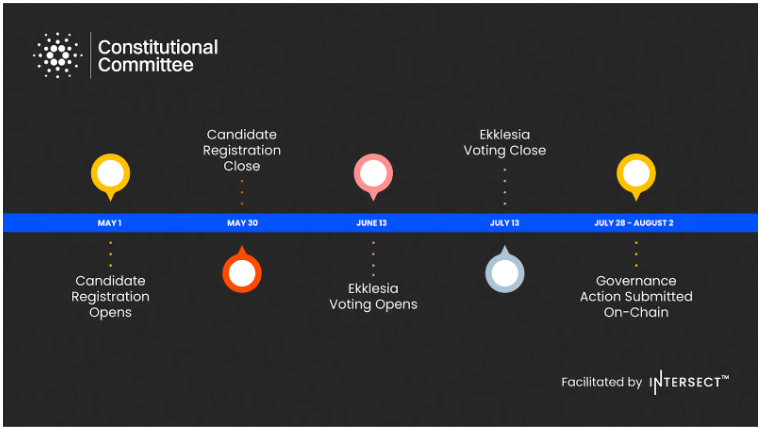
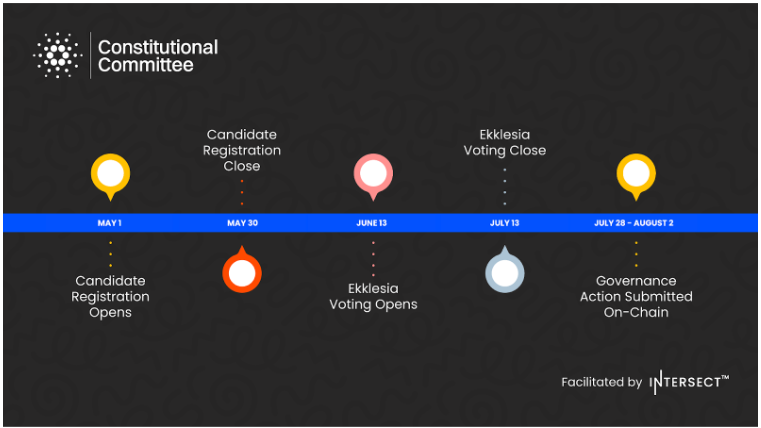
The Timeline:
- May 1: Registration opens for candidates.
- May 30: Registration closes.
- June 13: Voting opens on Ekklesia (at the Epoch boundary).
- July 13: Voting closes (at the Epoch boundary)
- July 28 – August 2: The "Update Committee" governance action will be submitted on-chain.
What’s at Stake?
Four seats are up for election this year:
- Cardano Curia
- Phil_uplc
- KtorZ
- Cardano Japan Council
If any of these current members wish to continue their service, they must submit their candidacy as any other applicant would. Note that the remaining three CC members have terms extending into next year, so their seats are not up for election this cycle, ensuring essential continuity within the group.
Who Can Run?
In keeping with Cardano's inclusive ethos and the guiding principles of the Cardano Constitution, participation is open to the entire community. Any ada holder is eligible to put themselves forward. We welcome applications from:
- Individuals
- Consortiums
- Companies
This diversity ensures that a wide range of technical, legal, and community perspectives are represented in the constitutional oversight process.
The Difference between the Constitutional Committee (CC) and Intersect Committees
Unlike the Intersect committee elections (currently ongoing), which are internal to Intersect’s membership and focused on operational advice and guidance, the Constitutional Committee (CC) election is open to the entire Cardano community. While Intersect committees (like Budget, Civics or Technical Steering) require paid membership to run or vote, the CC is a foundational pillar of on-chain governance.
It is important to note that Intersect does not control the CC; Intersect simply facilitates an election process to ensure it is professional, transparent, and secure. Any ada holder can stand for election, and every registered DRep has a say in who will act as the constitutional guardrails for the blockchain.
How Voting Works
The election will be conducted off-chain via the Ekklesia platform, following a structured process to ensure fairness and transparency:
- Eligibility: All registered DReps are eligible to vote.
- Voting Power: A DRep’s delegated voting power counts in full for each candidate they select.
- Candidate Selection: Each DRep can vote for up to 4 candidates (corresponding to the 4 open seats).
- Flexibility: Votes are not final until the window closes. You can change your selections at any time throughout the voting period.
- Audit: At the Epoch boundary on July 13, the voting window will lock. To ensure the highest level of integrity, the raw voting data will be handed over to a third-party auditor. The auditor’s role is to verify the correctness and technical validity of the votes, ensuring the final tally accurately reflects the community's will.
What’s New This Year?
We are constantly refining the process to ensure the transition is seamless and secure. This year, we are introducing two major changes:
1. Mandatory Credentials at Registration
In previous years, generating credentials before registering was optional. This year, it is mandatory. The CC must maintain a committeeMinSize (currently set at 7). If the governance action fails because a candidate isn't ready, we risk an inactive committee. By providing credentials upfront, candidates prove they are technically prepared to step into the role immediately, reducing the risk of halting governance.
2. The "Info Action" Awareness Campaign
To ensure a robust turnout, an Info Action will be submitted on-chain exactly one epoch before voting begins. This serves as a formal "nudge" to all DReps (Delegate Representatives), ensuring they are informed and ready to participate on Ekklesia.
Engagement & Support
The election process is designed to be transparent and interactive. To help the community get to know the candidates:
- X (Twitter) Spaces: Intersect will host dedicated sessions for candidates to share their visions.
- Community Forums: We encourage third-party debates and Q&A sessions.
Regular AMAs: Intersect will host open sessions to answer technical or procedural questions. Sign up for a session here.
A Call to Action
Serving on the Constitutional Committee is a unique opportunity to contribute directly to the stewardship of the ecosystem. If you are passionate about Cardano’s principles and its future direction, we strongly encourage you to register.
With the new requirement of mandatory credentials at registration, it is highly recommended that those considering applying who may not be familiar with the technical processes of the Constitutional Committee, use the time available pre-registration to educate and familiarise themselves. The original governance testnet SanchoNet is now a community run testnet focussed on providing a safe environment for governance education and testing.
Reach out to Mike Hornan, Email: (Mike Hornan) X: https://x.com/Hornan7 for further details on SanchoNet.
Links:
SanchoNet website - https://sancho.network/tutorials/committee
Cardano.org documentation - https://developers.cardano.org/docs/get-started/infrastructure/cardano-cli/governance/constitutional%20committee