Recent Cardano Governance Actions
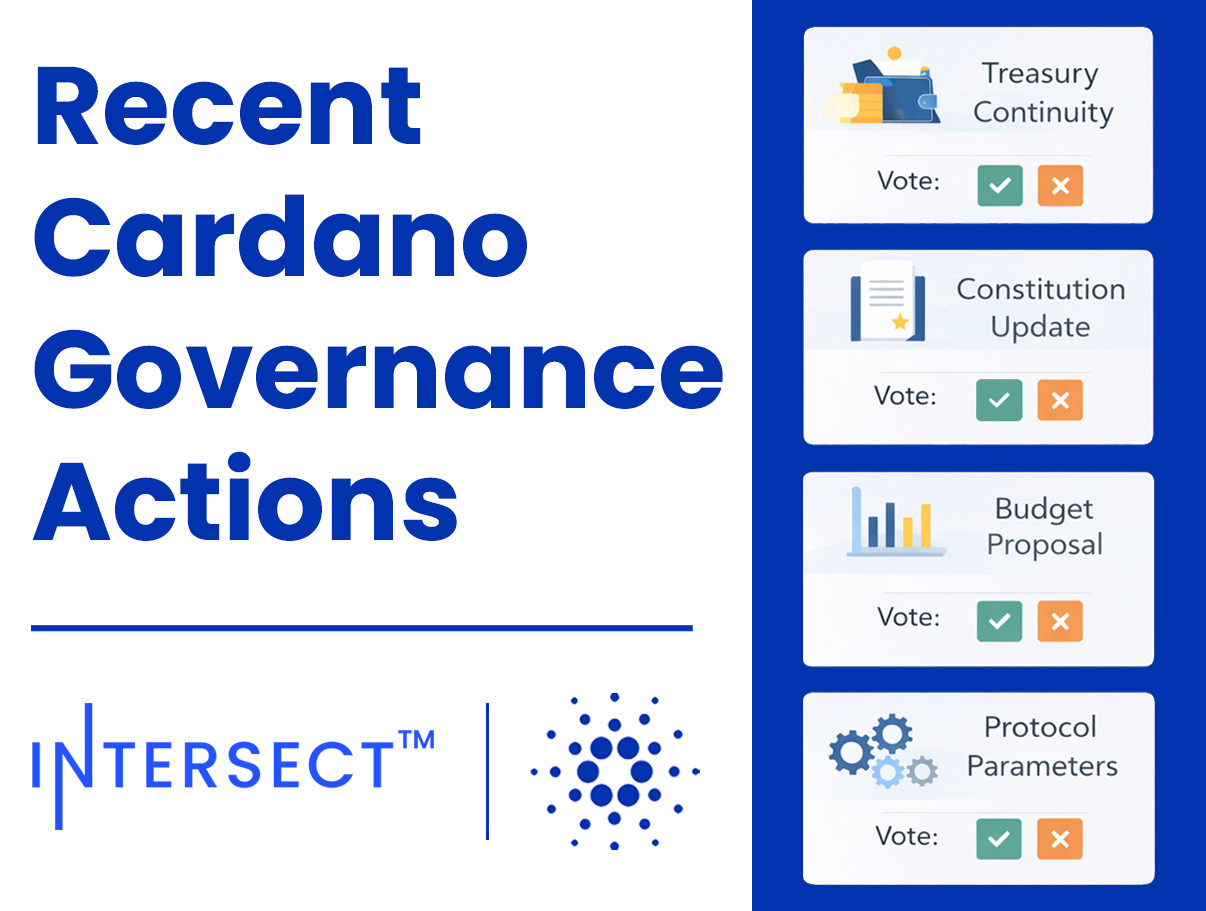
As 2025 closed and 2026 began, Cardano’s on-chain governance framework moved decisively from design to day-to-day operation. Over the holiday period, governance mechanisms were actively exercised across a broad range of actions, testing not only individual proposals but the system’s ability to operate continuously under real conditions.
These actions span critical areas of governance, including maintaining treasury continuity, restoring and strengthening the Constitutional Committee functionality, refining the Constitution based on early experience, and establishing shared direction for Cardano’s long-term strategy. Together, they reflect a governance system that is no longer theoretical but actively coordinating decisions, safeguards, and accountability on-chain.
This post provides an overview of the most recent governance actions, those that have expired, those currently active, and a brief look at what is coming next, offering a snapshot of Cardano governance in motion.
Extending the 2025 Net Change Limit to Ensure Treasury Continuity
A governance action submitted in November proposed an extension of the 2025 Net Change Limit (NCL) to avoid disruption to Cardano’s treasury operations.
The original 2025 NCL, adopted in April 2025, set a maximum cap of 350 million ada on treasury withdrawals from the start of Epoch 532 through the end of Epoch 604. Under the Cardano Constitution, treasury withdrawals that would exceed the active NCL are not permitted, and treasury withdrawals are subject to a one-epoch enactment delay.
Without an extension, this timing constraint would have sharply limited the window for valid Treasury Withdrawal governance actions to be ratified and enacted before the NCL expired.
The action, therefore, proposed extending the existing Net Change Limit by 8 additional epochs, with its expiration at the conclusion of Epoch 612 (February 8, 2026). Importantly, the spending cap itself remains unchanged: all previous withdrawals continue to count toward the original limit.
Approval of a Net Change Limit requires support from more than 50% of active DRep voting stakeholders. By meeting those requirements, the extension ensures continuity of treasury governance while preserving the community-approved spending ceiling.
Restoring the Constitutional Committee to Full Functionality
Following the Chang Hard Fork and the subsequent Plomin upgrade, Cardano transitioned from interim governance into full minimum viable on-chain governance as described in CIP-1694. As part of that transition, the interim Constitutional Committee was replaced with a fully community-elected committee consisting of seven members, aligned with the committeeMinSize protocol parameter.
During epoch 597, the Cardano Atlantic Council formally resigned before the end of their term. This reduced the number of active members to six, placing the committee below the required minimum and preventing any further ratification of governance actions that require Constitutional Committee approval until a replacement had been found.
To address this, a governance action was submitted on December 9 proposing the addition of a new committee member, selected through a snap election facilitated by Intersect. The election followed constitutional guardrails and relied on audited, stake-weighted DRep voting.
The election resulted in the selection of Cardano Curia, and the governance action ratifying this outcome passed on December 15. The short interval between submission and ratification made this the fastest governance action to be ratified to date.
With the ratification complete, the Constitutional Committee returned to its minimum required size, re-enabling full on-chain governance. Cardano Curia’s term aligns with the vacated seat and expires at epoch 653, while all other committee memberships and term expirations remain unchanged.
A Proposal to add an additional CC member
Following the restoration of the Constitutional Committee, a second governance action was submitted on December 15. This proposal is currently active, with voting open until January 14, and requires approval by both DReps (67% in favor) and stake pool operators (51% in favor).
This action was submitted independently by the community members, proposing adding the runner up in the snap election, Christina Gianelloni, as an additional Constitutional Committee member, increasing the committee size above the minimum threshold from seven to eight members.
The motivation as per the governance action, is to reduce operational risk. While governance functionality was restored by returning the committee to its minimum size, operating exactly at that threshold leaves little margin for unexpected resignations during the current mandate.
The proposal explicitly references the previously ratified Curia Update Committee action as its previousGovActionId, ensuring correct ledger ordering and preventing conflict. It does not remove or replace any existing committee member, does not change voting thresholds, and does not alter existing committee terms.
If ratified, it would add Christina as an additional member, and she would serve until epoch 653, consistent with the term established during the snap election process.
A Community-Led Vision for Cardano’s Long-Term Direction
On December 17, an Info Action was submitted seeking community support for a proposed Cardano 2030 Vision and Strategy, with voting open until January 19.
This work was facilitated by the Product Committee of Intersect and followed an extensive community process spanning late 2024 and 2025. More than 700 participants contributed input through surveys, workshops, focus groups with stake pool operators, business discussions, and conversations with founding entities, including IOG, the Cardano Foundation, and EMURGO.
The proposed Vision positions Cardano as the most secure, reliable, and censorship-resistant blockchain for mission-critical applications, supported by a Mission statement and a Strategy Framework built around five strategic pillars:
- Infrastructure & Research Excellence
- Adoption & Utility
- Governance
- Community & Ecosystem Growth
- Ecosystem Sustainability & Resilience
This Info Action does not introduce binding rules or amend the Constitution. Instead, it provides a shared strategic reference point intended to help DReps evaluate proposals and treasury allocations against long-term ecosystem goals.
Constitution v2.4: Refinement Through Practice
On December 18, a governance action to update the Constitution was submitted, proposing the adoption of Cardano Constitution v2.4, with voting open until January 19. If ratified, this proposal would amend the Constitution directly.
Constitution v2.4 focuses on improving clarity, enforceability, and consistency based on early governance experience. Key changes include:
- Removal of non-binding expectations and encouragement clauses
- Elimination of the Budget Info Action mechanism, with safeguards consolidated into Treasury Withdrawal actions
- Introduction of immutability requirements for proposal documents
- Addition of clearer terminology and defined terms
The proposal also incorporates feedback from EMURGO by reverting three wording changes introduced in v2.3 back to their original v1.0 language, aiming to preserve broad consensus while continuing constitutional refinement.
Budget Info Action: DeltaDeFi and Hydra-Based Trading Infrastructure
On December 29, a Budget Info Action was submitted with a voting deadline of January 29. The proposal asks DReps and the broader community to signal, in principle, support for allocating 1,500,000 ada over six months to harden and scale DeltaDeFi, a Hydra-based, low-latency order-book exchange.
As a Budget Info Action, this proposal does not move funds. Instead, it records community sentiment on whether this scope and direction of spending is desirable, with any future funding requiring a separate Treasury Withdrawal governance action.
The proposal positions DeltaDeFi as infrastructure intended to address a gap in Cardano’s DeFi landscape: the absence of a production-grade order-book venue capable of supporting professional, API-driven trading with predictable execution quality. A notable element of the proposal is its integration of a Vision 2030 KPI Measurement Programme, designed to make ecosystem impact measurable through baseline reports, a public dashboard, and a six-month progress assessment.
Governance Actions in the Pipeline
On behalf of the Intersect committees, Intersect plans to submit multiple governance actions this quarter.
Intersect’s Cardano Budget Committee
The next Net Change Limit (NCL) following the recent extension – establishes the total amount of ada that can be withdrawn from the Treasury within a set period. The 2025 (current) NCL, together with the approved extension, is set to expire in February. The Budget Committee at Intersect have now proposed the next NCL at 350m ada and will submit a new NCL Info Action to ensure continuity and fiscal alignment for the upcoming budget cycle.
Budget Process Framework 2026 Info Action – the draft Budget Process Framework 2026 introduces a clearer, more transparent, and data-driven approach to budgeting. It establishes standardized templates, structured review stages, and earlier access to consistent information, helping DReps make informed decisions while reducing complexity. Intersect is now working with members, DReps, and ecosystem stakeholders to refine the framework together before submitting the final proposal on-chain.
Intersect’s Technical Steering Committee
The Technical Steering Committee (TSC) has pencilled in two governance actions.
- Raising Plutus Memory Limits – The Technical Steering Committee has ratified the recommendation from the Parameters Committee to increase the Block and Transaction Plutus Script memory Limits. For more information, please see Improving innovative contract capacity: Parameter updates enter Cardano testnet. The next step is to put this action on the mainnet.
- Hardfork Naming Info Action – Following the precedent set for the Plomin hardfork, it is likely that the reforming Hardfork Working Group recommends to the TSC to submit an Info action to gain consensus for the naming of Cardano’s next hardfork. The hard fork itself is planned for early this year.
- Reducing Minimum Constitutional Committee Size – Following the discussion of the proposed Parameter Change Request, it is likely that the Parameters Committee will pursue reducing the committeeMinSize parameter.
- Intra-era hard fork initiation – Preparation works are ongoing for Cardano’s next upgrade, see details; Proposed Intra-Era Hard Fork to Protocol Version 11. While the submission timeline has not yet been determined by the hard fork working group, the upgrade is expected to occur this quarter.
Taken together, these actions illustrate a governance system that is now operating continuously rather than episodically. Treasury controls, committee functionality, constitutional refinement, and strategic alignment are no longer abstract mechanisms, but active components of Cardano’s day-to-day decision-making.
As additional governance actions move through the pipeline, the focus in 2026 continues to shift toward coordination, execution, and reliability. Ongoing transparency around how governance is exercised and how safeguards are applied in practice will remain essential as the ecosystem scales and expectations continue to rise.